
What is Contemporary Lusophone African Art? open CALL for PAPERS now!

Guest Editors: Paul Goodwin & Lúcia Marques
email: goodwinandmarques@gmail.com
Abstracts written in English, (500 words max.) including the manuscript’s title, should be sent by email attachment no later than 21st July 2011!
(upon acceptance, final papers are due by 1st February 2012)
Open CALL FOR PAPERS to a SPECIAL ISSUE of Third Text
Guest editors: Paul Goodwin & Lúcia Marques
One of the most striking aspects of the globalization of the art world is the massive increase in interest in the work of contemporary African artists. This has been reflected in the spectacularly enhanced presence of African artists in global Biennial exhibitions, museum collections and in commercial galleries and art fairs. The tremendous growth of interest in contemporary African art has been matched by a deluge of scholarly texts, journals and books dedicated to this subject such as the important, encyclopedic collection ‘Contemporary African Art Since 1980’ by Okwui Enwezor and Chika Okeke-Agulu (2009, Damiani Press).
However on closer inspection it is apparent that the geographies of African art presented in these studies is skewed towards an Anglophone (and Francophone to a lesser extent) perspective of ‘contemporary African art’. In particular ‘Lusophone’ Africa is poorly represented if at all. Although there are several Lusophone artists in Enwezor and Okeke-Agulu’s anthology, there is no analysis of the specific context of Lusophone African art production in the text. ‘Lusophone’ is not even mentioned in the index. This absence or neglect is, in fact, quite common in presentations of contemporary African art in the English speaking world. This lacuna is one of principal rationales driving this Special Issue of Third Text.
We start with a question that is simple in appearance but tellingly complex at the same time: What is contemporary Lusophone African art? Under question here are a number of key terms that need to be unpacked if we are to address this issue in a critical and challenging way: ‘contemporary’, ‘Lusophone’, ‘African’ and ‘art’. Each term is contested territory in its own right but in bringing them together within an interrogative form we are striving to open up a discursive platform in which these complex terms can be debated, critiqued and repositioned. For example, so-called ‘Lusophone Africa’ is not a seamless whole. It includes a variety of countries each with very different social, political and cultural histories. In acknowledging this complexity, it is the hope of the editors that a significant gap in the geography of knowledge production of contemporary African art can begin to be addressed and in turn generate more research and debate across language and cultural borders.
Contributors to this special issue of Third Text are invited to present papers and book reviews that address this question: ‘What is contemporary Lusophone African Art?’. By questioning the label of ‘contemporary Lusophone African Art’ we intend to gather a number of manuscripts that can debate the existence of an artistic production with a circumscription mainly related to a colonial language heritage.
This geographical focus which relates to the international circulation of young artists coming from Portuguese-speaking African countries will be the starting point to question the on going mapping of ‘Lusophony’, ‘Francophony’, ‘Anglophony’ by ex-colonial powers under the pretext of ‘shared’ languages and cultures. This is frequently seen either as ‘neo-colonial’ appropriation by institutionalised powers (especially in political events), or as a strategic entry point into the international artistic circuits that some artists can take advantage of.
In this sense, a reflection about ‘contemporary Lusophone African Art’ in a post-colonial context should also stimulate a variety of studies by authors beyond the ‘Lusophone’ cartography, encouraging perspectives from the various ‘Africas’. We call for contributions which favour a transdisciplinary approach, including comparative studies, giving priority to those which, under a theoretical or empirical perspective, question the conceptual bases, the possibilities, the limits and the borders of ‘contemporary Lusophone African Art’.
The following are some themes and questions suggested by the editors to be addressed by potential contributors. These suggestions arise from the editor’s research and discussion and are by no means exhaustive:
1) Does ‘contemporary Lusophone African Art’ exist?
2) (De)construction of African Identities through artistic expressions
3) The role of art as interface between trends and imported cultural models
4) Art and political intervention
5) Artistic responses to war, conflict an armed struggle: the relationship of artistic production to independence movements
6) Notions of diaspora, ‘race’ and national identity. Is there a Lusophone ‘South Atlantic’ that links Africa, Brazil and Portugal that is analogous to Paul Gilroy’s ‘Black Atlantic’?
7) Rise of biennials and triennials (eg. Luanda Trienniale). How does ‘Europe’ contribute to the project of ‘African Art’ in Lusophone contexts?
This special issue invites contributions, not exceeding 6000 words in length, from artists, art historians, theoreticians and intellectuals interested in exploring through original manuscripts any of the issues pertaining to ‘What is Contemporary Lusophone African Art?’. The authors’ names and corresponding bibliographic references (500 characters max.) must be included in the document’s title page, which must also have the authors’ institution. The submitted manuscripts must be accompanied by five keywords and when preparing the manuscripts, authors must observe the formatting and the submission regulations of Third Text journal (available at http://www.thirdtext.com/authors-guidelines/). Manuscripts must be submitted in English. In exceptional circumstances only we may be able to provide some help for translation of texts.
Abstracts written in English, (500 words max.) including the manuscript’s title, should be sent by email attachment no later than 21st July 2011 to the Guest Editors Paul Goodwin & Lúcia Marques at goodwinandmarques@gmail.com (upon acceptance, final papers are due by 1st February 2012).
The Editors:
Paul Goodwin is a curator, urban theorist and researcher. He is an Associate Research Fellow at the Centre for Urban and Community Research, Goldsmiths College and Curator of Contemporary Art at Tate Britain.
Lúcia Marques is a Lisbon based independent curator. She is President of XEREM cultural association (Triangle Network) and a member of AICA-International Association of Art Critics.
workshop HOME & ABROAD book launch!

BOOK LAUNCH, both in London and Lisbon, HOME & ABROAD!
a XEREM edition in partnership with TRIANGLE NETWORK
design by MusaWorkLab
You can find it here: http://xerem.org/pt/en
22nd February, 7pm
GASWORKS, London / United Kingdom
website: http://www.gasworks.org.uk/
26th February, 6pm
CARPE DIEM-Arte e Pesquisa, Lisbon / Portugal
website: http://carpediemartepesquisa.wordpress.com/
Estreia europeia de "Intercontinental_BR_0077" (Miguelangelo Veiga & Susana Guardado) no DROP-D contemporary space, em Lisboa

Capa do catálogo do festival “In the Loop: Contemporary Video Art from The European Union", Washington DC (Junho 2010)
No dia 12 de Janeiro de 2011 (4f), das 19h30 às 23h00, no novo espaço lisboeta DROP-D (que o artista eborense David Rosado tem programado desde Setembro de 2010) houve sessão de apresentação do vídeo "Intercontinental_BR_0077", de Miguelangelo Veiga e Susana Guardado, que representou Portugal no festival “In the Loop: Contemporary Video Art from The European Union" em Washington DC (Junho de 2010).
Intercontinental_BR_0077 deriva de um processo de trabalho partilhado por dois autores situados em dois países Lusófonos. A partilha de ficheiros de texto, som e imagem é exclusivamente feita via internet, o que representa uma ideia de comunicação actual e ocidentalizada, entre duas pessoas em lugares distantes do globo.
Filmado inteiramente no Rio de Janeiro (Brasil), em vídeo digital (DV) e comprimido em MP4, é sonorizado e editado em Lisboa (Portugal). Esta obra, enquanto problematiza questões relacionadas com autoria e com o espaço de construção da obra, explora a linha ténue entre o Vídeo, a Fotografia digital. O objecto final resulta na interpretação do olhar e na manipulação de dados, de forma a conseguir criar um novo espaço de representação que existe exclusivamente na percepção do observador.
É um vídeo que escapa às regras elementares de uma realização com preocupações cinematográficas, ou de qualquer edição com pretensões narrativas ou documentais. Esta é uma peça que procura, acima de tudo, reformular estas questões, proporcionar debate e explorar a transdisciplinariedade própria deste suporte, colocando a liberdade do processo no centro da discussão.
Miguelangelo Veiga & Susana Guardado
O “Intercontinental_BR_0077” foi seleccionado pelos curadores Carolyn Carr e Rebecca Kasemeyer (da National Portrait Gallery), Ruth Perlin, Brooke Rosenblatt e Vesela Stretenovic (The Phillips Collection), Jack Rasmussen (do American University Museum no Katzen Arts Center) e Jefferson Pinder (University of Maryland) para representar Portugal no Festival “In the Loop: Contemporary Video Art from The European Union” a partir da seguinte shortlist (com curadoria de Lúcia Marques):
a) Stills and Frames of a Broken-Hearted Girl (2009), de Ana Barroso
b) All those heavy buildings in New York (2010), de André Príncipe
c) Intercontinental_BR_0077 (2010), de Susana Guardado & Miguelangelo Veiga
DROP-D contemporary space
Rua da Trindade, n.º 7 (perto do Largo do Carmo), Lisboa, Portugal
Tel. (+351) 963 625 674 | Email: dropdcontemporaryspace@gmail.com
Website: http://dropdcontemporaryspace.blogspot.com/
NEM PRINCÍPIO NEM FIM, com Sofia de Medeiros nos Açores


SOFIA DE MEDEIROS
A Promessa
O Pão do Bodo
O Fado
(2010)
Nem Princípio Nem Fim: Brincos de Princesa
um projecto de
SOFIA MEDEIROS
em co-curadoria com Lúcia Marques
no Museu Carlos Machado
Ponta Delgada, Ilha de S. Miguel * AÇORES
De 11 de Dezembro 2010 a 20 de Março de 2011
O Museu Carlos Machado acolhe, até 20 de Março de 2011, o mais recente projecto de Sofia de Medeiros. A artista propõe uma visão contemporânea das tradições culturais açorianas apresentando mais de uma dezena de trabalhos inéditos. Esta é a primeira exposição de uma trilogia dedicada ao feminino numa abordagem transinsular.
“Sempre ambicionei correlacionar aspectos das minhas raízes culturais açorianas com os meus projectos artísticos. O meu regresso à ilha veio proporcionar isso. É como se estivesse em residência artística prolongada, absorvendo o máximo do que o sitio me pode revelar. Neste sentido, o meu trabalho foca-se neste processo cultural de contacto e troca de diferentes experiências e reflexões artísticas pessoais.
No caso particular de Nem Princípio Nem Fim é um olhar feminino sobre o feminino, levantando questões sobre o papel tradicionalmente atribuído às mulheres portuguesas no espaço doméstico. Este projecto também é resultado de uma constante investigação de técnicas tradicionais ligadas aos lavores femininos antigos e aos tecidos de padrões tradicionais portugueses. É um constante diálogo e reflexão entre a tradição e a contemporaneidade, no sentido de uma interacção construtiva entre o que se define como valor local e universal.
Recorrendo a elementos de carácter simbólico que representam o universo imagético da cultura popular açoriana existentes nas mais diversas manifestações como os romeiros, as festas do Divino Espírito Santo, o Santo Cristo dos Milagres, o folclore, etc, são criadas obras, em tecido e em ferro, com técnicas tradicionais que pressupõem o “saber fazer”. O uso do ferro surge como contraste à moleza dos tecidos e sobretudo à sua masculinidade, tão característica deste material, em contraposição à feminilidade dos têxteis. Por vezes recorro à apropriação de formas já existentes, de modo a criar um discurso artístico contemporâneo pertinente no que diz respeito à busca de identidade cultural, provocando no espectador uma reflexão e conhecimento da influência que a tradição pode exercer na arte contemporânea.”
Sofia de Medeiros
+Info = www.museucarlosmachado.azores.gov.pt
Conversa na ArteIlimitada sobre curadoria

Francisco Vidal
Mural do Habitual, 2010
(foto: Rita GT)
"Práticas curatoriais em rede e outras estratégias de sobrevivência”
11 de Novembro de 2010, pelas 18H45
O papel do curador como efectivo mediador tem-se consolidado no meio artístico português apenas nos últimos anos, traduzindo novas metodologias de trabalho que também passam por uma maior participação em redes informais e institucionais de colaborações. A partir de estudos de caso que envolvem diversas geografias culturais, abordar-se-ão diferentes estratégias de sobrevivência cultural e artística num mundo dividido entre o global e o local.
Coordenação do ciclo de conferências da Arte Ilimitada: Leonor Nazaré
ARTEILIMITADA - Escola de Artes Visuais
Calçada da Estrela, 128, Anexo A, 1200-666 Lisboa
21.3956427 / 21.3954401
arteilimitada@sapo.pt | http://www.arteilimitada.com
"Pirataria e estudos sobre o Cavaleiro de Calatrava" em Santiago do CHILE, com Francisco Vidal


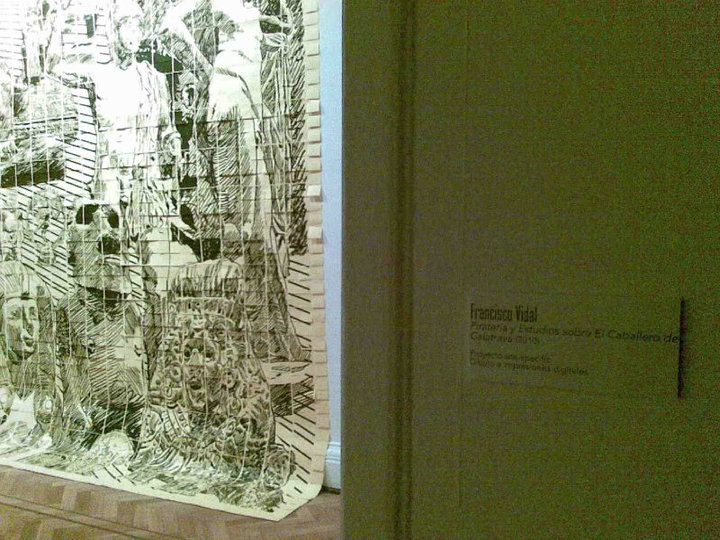
Imagens da instalação site-specific de Francisco Vidal no Museo Nacional de Bellas Artes em Santiago do CHILE (Agosto/Setembro 2010)
Lisboa-Berlim-Nova Iorque-Santiago: pintura, desenho e pirataria de Francisco Vidal
No ano em que se comemora o bicentenário da independência chilena (1810) e o centenário do MNBA - Museo Nacional de Bellas Artes chileno (1910), o MNBA decidiu realizar uma exposição internacional de arte contemporânea que reactualiza através de diversas abordagens o próprio acervo do Museu. Estava-se em 1910, quando a exposição inaugural do Museu, intitulada Exposición del Centenario, reuniu obras apresentadas pelos quinze países participantes, entre os quais Portugal (que então exibiu o retrato do Cavaleiro de Calatrava, pintado pelo caldense José Malhoa). Os restantes foram Alemanha, Argentina, Áustria, Bélgica, Brasil, Espanha, E.U.A., França, Holanda, Itália, Japão, Reino Unido, Suíça e Uruguai, tendo algumas das criações artísticas então mostradas sido doadas de modo a iniciar a colecção internacional que o MNBA celebra 100 anos depois em torno do grande tema das Migrações.
O processo constituiu desde logo uma migração de escolhas entre diferentes contextos: no caso português, a Embaixada, após convite do MNBA para participar neste evento, optou por convidar um curador que por sua vez escolheu um artista, ramificando assim as escolhas curatoriais da iniciativa, e privilegiando também a liberdade de suportes de apresentação dos projectos a seleccionar (“bidimensional ou tridimensional, audiovisual ou fotográfico, objectual ou instalação”). A escolha do artista recaiu por isso, ainda no final de 2008, no jovem pintor Francisco Vidal, na altura a viver em Berlim e cuja obra já tem abordado por diversas vezes o imaginário plástico de José Malhoa, conciliando-se ainda o conhecimento profundo do universo de Malhoa com diversas referências culturais associadas à sua própria biografia. Desde a relação com as Caldas da Rainha (Portugal), onde o jovem autor estudou – e se situa o Museu do próprio Malhoa – até à sua nova residência em Nova Iorque, ainda hoje considerada um dos mais importantes pólos artísticos internacionais, sem esquecer o cruzamento, na sua própria biografia, de dois dos países com histórias migratórias mais expressivas: Cabo Verde e Angola. A estas razões somou-se também uma experiência já considerável por parte do Francisco Vidal na realização de intervenções “site-specific”, como a que mereceu destaque da crítica no Prémio EDP Novos Artistas 2005, ou no Centro Cultural de Lagos, no âmbito do programa de Arte Contemporânea ALLGARVE (2008).O convite ao Francisco Vidal consistiu, portanto, num desafio para criar uma intervenção “site-specific” num espaço previamente atribuído pelo MNBA, podendo integrar anteriores trabalhos nos quais tivesse evocado obras seminais de José Malhoa.
Migrações, portanto: das histórias pesquisadas, das imagens que se encontraram e das ligações que se produziram, até chegarmos à vertigem da pirataria tão contemporânea de Francisco Vidal.
Subscrever:
Mensagens (Atom)